Just lend while tracking supplied assets, debt, account health, repayment and withdrawal
Just lend when you can trace what is supplied, what secures a debt and what must be cleared before exit. A crypto lending position can pass through supply, collateral activation, borrowing, adjustment, repayment and withdrawal. The lending account should record each confirmed position change, while its health measure shows whether the remaining collateral still supports the debt.
Supply and borrowing are related actions, but they do not create the same risk. Supplying alone may earn a variable return. Using supplied value as collateral introduces debt, a changing health state and possible liquidation.
In short: A full lending exit is complete only when the debt record is zero and the intended collateral withdrawal is confirmed; account health alone cannot prove closure.
Supplied assets set the borrowing boundary
Borrowing starts with the market rules attached to the supplied asset. The market may accept an asset for supply without allowing it to secure borrowing. If collateral use is available, the account gains borrowing capacity according to the asset valuation, the applicable collateral rule and any account-level limits.
That distinction matters before any debt appears. A supply-only position has exposure to the supplied asset, the lending mechanism and smart-contract operation, but it does not carry liquidation risk from an outstanding loan. Once the account borrows against collateral, falling collateral value or growing debt can reduce its safety margin.
Available liquidity also affects the action. An account may have adequate collateral yet remain unable to borrow or withdraw the desired amount when the relevant pool lacks liquidity. The account record should therefore be read together with the market state shown when the transaction is prepared.
Account health follows collateral, debt and market rules
Account health expresses the relationship between adjusted collateral support and the debt that the account owes. The displayed form varies by system. It may appear as a ratio, a factor, a margin or a warning state, so the threshold definition matters as much as the number.
Collateral value
Collateral value can move with the asset price and the valuation method that the market uses. The amount deposited may remain unchanged while its borrowing support rises or falls. A market can also change an asset parameter through its permitted governance or administrative process, which may alter the account state without a new user transaction.
Debt value
Debt includes the borrowed balance and any interest that accrues under the position rules. If collateral and debt use different units of account, their relative prices also affect health. A repayment normally reduces debt, although the confirmed account balance provides stronger evidence than the amount entered in a transaction form.
Liquidation threshold and account records
In overcollateralized lending, a position can become liquidatable when its risk measure crosses the market's configured threshold. The record worth monitoring usually includes:
- the supplied balance and whether it counts as collateral
- the outstanding debt balance
- the valuation used for each side of the account
- the displayed health measure and applicable threshold
- the confirmation state of recent adjustments
Authorization, supply and debt are separate states
Wallet authorization, network confirmations and lending account records show different states. Reading these states separately prevents an approval, a supply transaction and a borrowing transaction from being mistaken for the same event.
Asset authorization
A token-based market may require permission to transfer a specified asset from the wallet. That permission can persist after the next transaction and does not prove that any asset entered the lending account. Its scope and remaining allowance belong to the wallet's authorization record.
Supply confirmation
A confirmed supply should create an account balance or equivalent position record. Collateral status may require a separate choice, depending on the market. Confirm the lending account balance and collateral status instead of inferring borrowing capacity from a lower wallet balance.
Borrow confirmation
Debt begins when the borrowing action succeeds and the account records the obligation. The wallet receiving an asset supports that conclusion, but the debt balance and transaction result provide the clearer account-level evidence. Any displayed health change should correspond with the confirmed debt state.
Position cost changes with time and execution
The final cost comes from several inputs rather than one promised figure. Borrow interest can accrue while debt remains open, and a variable rate may change with market conditions. The rate shown before entry does not by itself establish the cost through exit.
Network execution costs sit outside the lending balance in many systems. Supplying, borrowing, adjusting, repaying, changing an authorization and withdrawing may each require a separate transaction. A successful repayment does not reimburse those network costs.
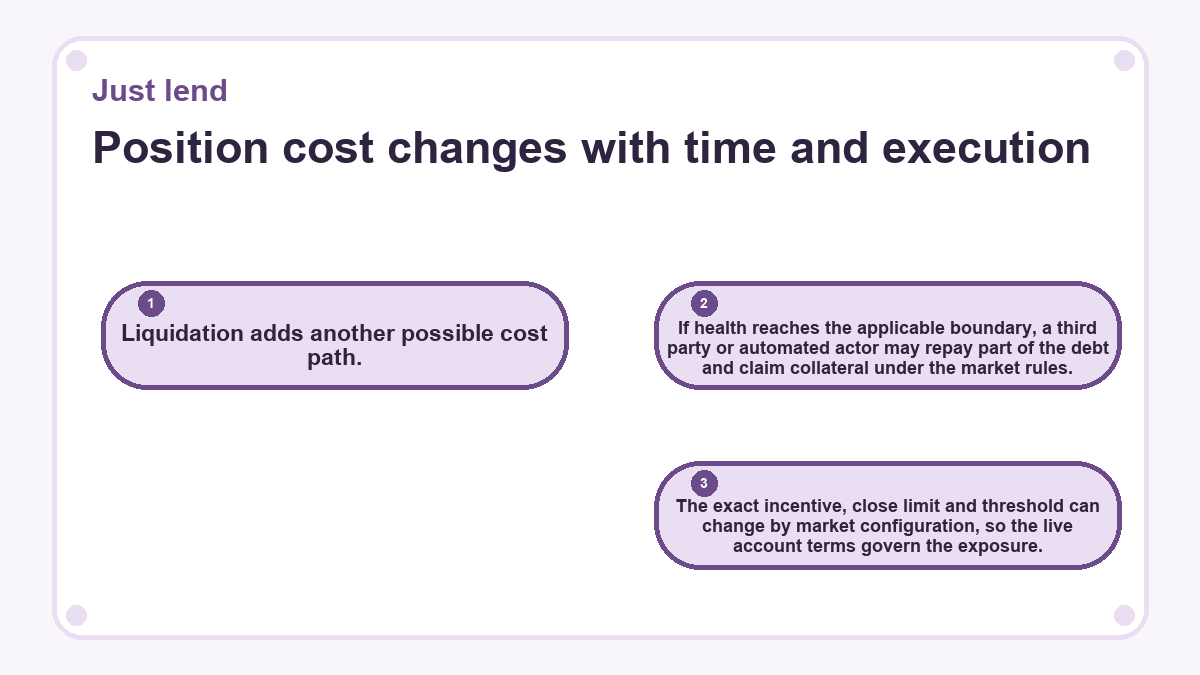
Liquidation adds another possible cost path. If health reaches the applicable boundary, a third party or automated actor may repay part of the debt and claim collateral under the market rules. The exact incentive, close limit and threshold can change by market configuration, so the live account terms govern the exposure.
What makes an adjustment reversible?
An adjustment can be offset only while the account rules still permit the opposite action. A user may supply more collateral, repay debt, borrow again or withdraw eligible value through later transactions. Those later actions do not erase the earlier records, and a confirmed blockchain transaction itself cannot simply be undone.
Liquidity and health rules limit that flexibility. Removing collateral may fail if it would leave insufficient support for the debt. Borrowing more can face the same health boundary, while repayment requires enough of the owed asset to cover the current debt, including accrued interest.
Pending actions deserve separate treatment. A submitted transaction has not changed the account merely because the wallet displayed a request. Confirmation, the updated debt or supply balance and the resulting health state establish whether the adjustment took effect.
A hypothetical route to a verifiable closed position
All quantities and rates in this example are hypothetical. Suppose the account shows supplied collateral valued at 1 278 accounting units and a planned principal of 638 units. The reader first records the displayed health state, the market threshold and the estimated execution cost before deciding whether the borrowing action fits the constraint.
As an independent arithmetic check, collateral value divided by planned principal is about 2.003. That quotient is not the protocol's health measure because collateral adjustments, debt accrual and valuation rules may change the official calculation. It only confirms how the two entered values relate before execution.
- Confirm that the supplied balance counts toward collateral support.
- Submit the hypothetical 638-unit borrowing transaction and wait for a successful result.
- Check that the account now shows debt and a corresponding health state.
- At exit, repay the full displayed obligation rather than relying on the original principal.
- Verify a zero debt record, request withdrawal of the supplied collateral and confirm that a successful withdrawal removed it from the lending position.
The requested principal alone cannot predict the final cost. Time, the applicable rate and any market-specific adjustments affect the repayment amount. Execution charges add to the overall cost instead of the debt balance. For this full-exit scenario, the valid end state is a confirmed zero debt balance followed by separate evidence that the intended collateral amount left the lending position.
Health adjustments need network and account confirmation
A partial repayment, added collateral or smaller debt can improve the displayed health state, but the wallet transaction and account record must agree. A confirmation proves that the network processed an action; the revised balance shows how the lending system applied it. If the interface has not updated, the underlying account state and transaction result help distinguish display delay from failed execution. A safer ratio does not close the position while any debt remains.
Exit requires separate debt and asset confirmations
A complete exit separates debt closure from collateral release. Repayment removes the obligation when the account records no remaining debt. Withdrawal then moves eligible supplied value out of the lending position, subject to available liquidity and any other position constraints.
Debt closure
The amount required at closure can exceed the original principal because interest may have accrued. Entering the old principal may leave a residual balance. The decisive evidence is the post-transaction debt record, not a rounded estimate or the amount that the wallet attempted to send.
Collateral release
Collateral becomes releasable only after the account rules permit the withdrawal. A zero debt balance may remove the health constraint, but pool liquidity can still affect immediate access. Withdrawing part of a supply also leaves a continuing position, even though the credit obligation has ended.
The wallet balance, transaction result and lending account should converge on the intended state. If one still shows debt, supplied value or a pending action, the exit remains incomplete in that specific respect.
The retained record informs the next credit decision
After closure, retain the identifiers and account states that connect supply, borrowing, adjustments, repayment and withdrawal. They can help reconcile accrued cost, distinguish principal from execution expense and show whether an authorization remains active even though the lending balance reached zero.
The next decision starts with the condition that ended the previous position. Compare the remaining wallet authorization, available liquidity and current health rules with the new intended action. Use that comparison to decide whether to reuse the setup, reduce exposure or leave the assets outside the lending market.
Just lend - your questions answered
Does supplying crypto guarantee a positive return?
No, supplying crypto does not guarantee a positive return. The supply rate may change with utilization and market rules, while asset-price movement, execution costs, smart-contract failure or a token problem can outweigh credited interest. The position's result depends on the assets recovered at withdrawal, credited interest, execution costs and the prices used to value them.
Why can the displayed health measure change when I do nothing?
Account health can change without a new wallet transaction because collateral prices, debt prices and accrued interest may keep moving. A market can also apply an authorized parameter change that affects collateral support or a risk threshold. Review the values behind the measure before assuming that the interface has made an error.
Which record proves that a borrowing transaction completed?
The strongest proof combines a successful transaction result with a nonzero debt balance in the lending account. A wallet receipt alone may show only that an asset arrived, while a submitted request may still fail. The resulting health state should also reflect the new obligation once the system processes the transaction.
Is a confirmed wallet transaction enough to prove that the account closed?
A confirmation alone does not prove complete closure. The transaction may represent a partial repayment, an approval or a withdrawal that left debt behind. Check for a zero debt balance and the intended collateral status, then confirm that no relevant account changes remain pending before treating the intended exit as complete.
When should a token spending approval be reviewed?
Review an approval when the authorized application no longer needs to transfer the asset or when its scope exceeds the intended action. Repaying debt or withdrawing funds does not necessarily cancel that permission. Changing or revoking the approval is a separate transaction and does not alter a remaining lending balance by itself.
Could stable-value collateral still create liquidation risk?
Yes, stable-value collateral can still support a liquidatable position. Its market value may move away from the intended reference, debt can accrue interest and the market may change applicable risk parameters through its permitted process. Liquidation depends on the account's actual health measure rather than the asset's label.
Do I need to withdraw supplied assets immediately after repaying debt?
No, repaying debt and withdrawing supplied assets are separate choices. A zero debt balance can end the credit obligation while the supply position remains open. Leaving assets supplied may continue the position under its current rules, risks and variable return, while withdrawal also depends on available liquidity.
What determines the final cost of a lending position?
The final cost depends on the borrowed balance, elapsed time, applicable interest method and execution expenses for each required transaction. Liquidation can create an additional loss path if account health crosses the market threshold. The original principal or opening rate alone cannot establish the amount paid through exit.